
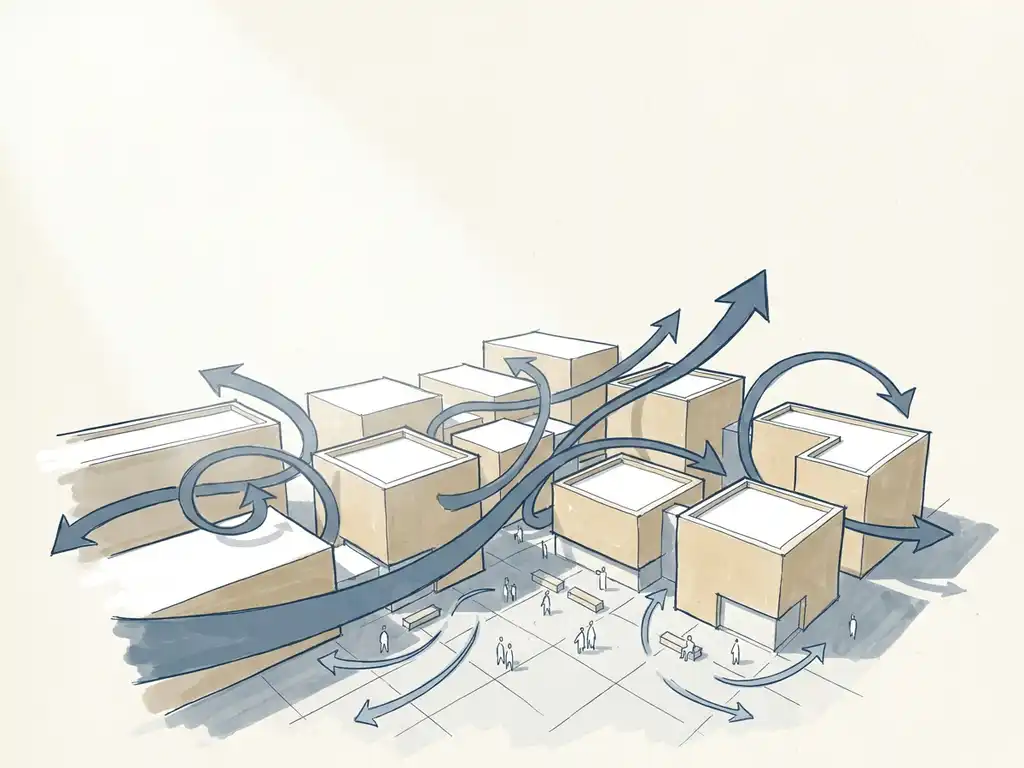
In 2026, the two main pedestrian wind comfort standards are NEN 8100 (used in the Netherlands) and the Lawson criteria (used in the UK, Canada, and internationally). Which one applies to your project depends on where you are building and what your permit authority requires. Both standards classify wind conditions around buildings based on exceedance probabilities at pedestrian height, but they use different thresholds and activity categories. Below, we walk through each standard, how they compare, and what you need to get a compliant assessment done.
Which pedestrian wind comfort standard applies to your project?
The standard that applies depends on your project location and the requirements of the local permit authority. In the Netherlands, NEN 8100 is the legally prescribed standard for permit procedures. For projects in the UK, Canada, and most international contexts, the Lawson criteria are the accepted benchmark. Some countries and municipalities have their own local guidelines, but most trace back to one of these two frameworks.
If you are working on a project in the Netherlands and need to submit a wind study as part of a permit application, NEN 8100 is not optional — it is the norm referenced in the regulatory process. For international projects, particularly in the UK, the Lawson method is what planning authorities and urban designers expect to see. In practice, projects in Belgium and other parts of Europe often use the Lawson criteria as a practical reference, since no single national standard dominates in the same way NEN 8100 does in the Netherlands.
When in doubt, check with the municipality or planning authority early. Getting this wrong means redoing the assessment in a different format, which costs time you probably do not have.
What wind comfort classes and activity thresholds do the main standards define?
Both NEN 8100 and the Lawson criteria classify wind conditions by linking wind speed thresholds to specific outdoor activities. The key difference is how each standard structures those activity categories and what exceedance probability is considered acceptable.
NEN 8100 comfort classes
NEN 8100 defines five wind comfort classes (A through E) based on how often wind speeds exceed 5 m/s at eye height (1.75 m above ground). The lower the class letter, the better the wind comfort.
- Class A: exceedance less than 2.5% of the time — good for sitting, strolling, and walking through
- Class B: 2.5–5% exceedance — good for strolling and walking through, moderate for sitting
- Class C: 5–10% exceedance — acceptable for sitting, moderate for strolling, poor for walking through
- Class D: 10–20% exceedance — moderate for sitting, poor for strolling and walking through
- Class E: more than 20% exceedance — poor for all activities
Lawson activity thresholds
The Lawson criteria take a different approach. Instead of one wind speed threshold for all activities, each activity has its own threshold speed, and all of them share the same maximum exceedance probability of 5%.
- Sitting: wind speeds above 4 m/s must not exceed 5% of the time
- Standing: threshold is 6 m/s, max 5%
- Strolling: threshold is 8 m/s, max 5%
- Walking through: threshold is 10 m/s, max 5%
- Uncomfortable: speeds above 10 m/s occurring more than 5% of the time
How does NEN 8100 differ from the Lawson criteria?
The most important difference is that NEN 8100 uses a single wind speed threshold (5 m/s) for all activities, while the Lawson criteria assign a different threshold speed to each activity. This makes NEN 8100 more sensitive to moderate wind conditions and generally produces more conservative results in the lower comfort classes.
In practical terms, this means the Lawson method can produce more optimistic assessments in urban environments with moderate wind exposure. Research from the Rotterdam pilot study confirmed this: under the Lawson criteria, only the Erasmusbrug was flagged as uncomfortable, while several other locations in the city clearly caused discomfort in practice. NEN 8100 captured those problem areas more accurately.
Another difference worth noting is seasonality. NEN 8100 does not distinguish between summer and winter by default, though separate seasonal analyses are increasingly recommended — especially for studies focused on the quality of public spaces. The Lawson method also does not mandate seasonal splits, but the underlying meteorological data can be segmented.
For wind engineering projects that span both the Netherlands and international markets, it is sometimes useful to run both assessments in parallel. This gives you a complete picture and makes the results defensible across different regulatory contexts.
What wind speed thresholds define a wind hazard under current standards?
Wind hazard is a separate classification from wind comfort. Where comfort looks at how often moderate wind speeds occur, wind hazard focuses on the risk of physical danger from high wind speeds — specifically speeds above 15 m/s at pedestrian height.
Under NEN 8100, the hazard classification works as follows:
- No risk: exceedance of 15 m/s less than 0.05% of the time (fewer than 4.5 hours per year)
- Limited risk: exceedance between 0.05% and 0.30% (4.5 to 26 hours per year) — sometimes acceptable depending on location and use
- Dangerous: exceedance above 0.30% (more than 26 hours per year) — always unacceptable
The Lawson criteria handle wind hazard differently, with two separate thresholds:
- Speeds above 15 m/s occurring more than 0.025% of the time — risk for vulnerable users
- Speeds above 20 m/s occurring more than 0.025% of the time — risk for all pedestrians
Locations that fall into the dangerous or hazardous category are not simply uncomfortable — they present a real safety problem. Design changes at the building or urban planning level are required before a permit can be granted.
Has anything changed in pedestrian wind comfort standards since 2024?
The core frameworks — NEN 8100 and the Lawson criteria — have not been replaced or fundamentally revised since 2024. Both remain the active references for pedestrian wind comfort assessments in 2026. What has evolved is how assessments are carried out and how results are used in design processes.
One notable shift is the growing use of more recent meteorological datasets. The NPR 6097 dataset (1963–2002) remains legally prescribed for Dutch permit procedures under NEN 8100, but newer datasets like DOWA (Dutch Offshore Wind Atlas, 2008–2017) are increasingly used alongside it — particularly for studies that need seasonal breakdowns or higher spatial resolution. Both datasets produce comparable wind roses, with the dominant wind direction clearly from the southwest in the Netherlands.
There is also growing professional consensus that seasonal assessments — producing separate summer and winter comfort maps — should become standard practice, especially for public space studies. Winter conditions consistently produce worse comfort outcomes, and a single annual average can understate the problem. This is not yet a formal requirement under NEN 8100, but it is increasingly expected by municipalities and urban designers who want a complete picture.
The Actiflow overview page gives you a sense of how these developments are shaping the way wind assessments are structured and delivered today.
What inputs does a wind comfort assessment need to meet these standards?
A compliant pedestrian wind comfort assessment requires three main categories of input: a 3D model of the built environment, local meteorological data, and a clear definition of the intended use of each outdoor area.
For the 3D model, the assessment needs accurate geometry of existing and permitted buildings in and around the project site. In the Netherlands, this is typically built from publicly available geodata sources such as 3DBAG, BRT TOP10NL, and AHN. Details smaller than about one metre have negligible influence on results and are generally left out. Vegetation is included only where it forms larger clusters — individual trees do not significantly affect the simulation at building scale.
For meteorological data, a NEN 8100-compliant assessment in the Netherlands must use the NPR 6097 dataset. This covers the period 1963–2002 and is the legally required input for permit procedures. If you also want a seasonal breakdown or a more recent reference, DOWA data can be used in parallel.
The intended use of outdoor spaces matters because the comfort class requirements differ by activity. A terrace needs a better comfort class than a thoroughfare. Knowing which spaces are meant for sitting, strolling, or passing through helps the assessor determine where the thresholds are most relevant and where design adjustments would have the most impact.
In terms of process, the assessment can be carried out using CFD simulations or physical wind tunnel testing. CFD is the standard method for larger or more complex sites — it handles city-scale geometry and multiple wind directions without requiring a physical model. Wind tunnel testing remains useful for individual buildings or smaller masterplans where physical validation adds value.
How Actiflow helps with pedestrian wind comfort assessments
We carry out pedestrian wind comfort assessments for architects, developers, structural engineers, and municipalities — across the full range of project types and scales. With over 21 years of experience and deep familiarity with both NEN 8100 and the Lawson criteria, we know what permit authorities expect and how to deliver results that hold up under scrutiny.
Here is what working with us looks like in practice:
- We advise you upfront on which standard applies to your project and what the assessment needs to cover
- We build accurate 3D models from geodata and run CFD simulations using validated software and meteorological inputs
- We produce colour-coded comfort maps and clear visual outputs that you can share directly with clients, planners, or permit authorities
- We flag wind hazard locations early so design changes can be made before they become costly
- We work across the Netherlands, Belgium, the UK, Gibraltar, the Middle East, and beyond — applying the right standard for each context
- For regular clients, we can start the next day if needed — speed and flexibility are part of how we work
Curious how we can help with your pedestrian wind comfort assessment? Contact us — we are happy to discuss your project and help you find the right approach. You can also learn more about us and our background in fluid dynamics engineering.
Related Articles
- Which 6 urban design features help reduce harmful wind speed?
- How does wind speed change between low and high-rise buildings?
- Why do tall buildings create wind problems at street level?
- How does wind flow change between low-rise and high-rise buildings?
- What is the difference between wind tunnel testing and CFD?
