
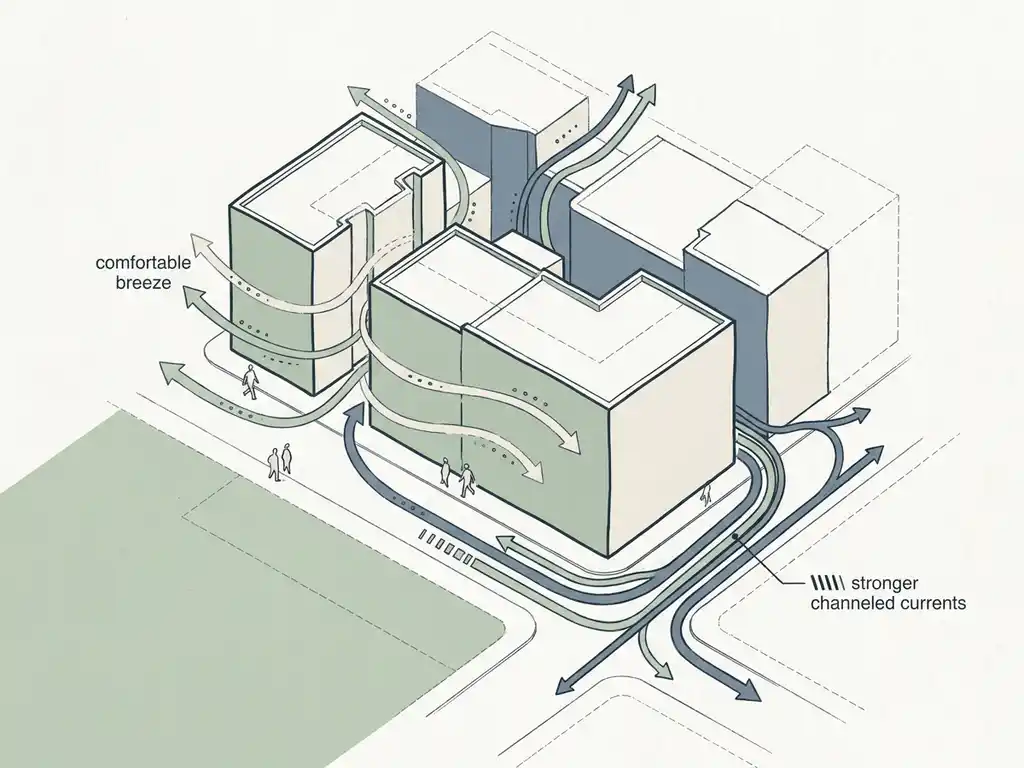
Wind comfort and wind safety are two separate assessments that measure different things. Wind comfort tells you how often wind speeds at pedestrian level make a location feel unpleasant for sitting, walking, or standing. Wind safety tells you whether wind speeds at that location ever reach a level that poses a physical danger to people. Both matter for building projects, but they use different thresholds and trigger different design responses.
The distinction becomes important the moment a project reaches the permit stage or when a municipality asks for a wind study. Understanding which assessment you need – and what the results actually mean – saves time and prevents surprises later in the design process.
How are wind comfort and wind safety measured differently?
Wind comfort is measured by looking at how often wind speeds exceed a relatively low threshold – typically 5 m/s at eye level – and comparing that frequency against the intended use of a space. Wind safety is measured by looking at how often wind speeds exceed a much higher threshold of 15 m/s, which represents the point at which people can lose their balance or be knocked over.
In practice, this means the two assessments use the same underlying wind data and simulation model, but they apply different filters to it. A wind engineering assessment for a new high-rise will typically produce both outputs from a single CFD simulation run. Comfort results are expressed as a classification per location – from class A (comfortable) to class E (unacceptable). Safety results are expressed as an exceedance probability: how many hours per year does wind at that location exceed 15 m/s?
The key difference in how the two are used is this: comfort results guide design decisions about where to place terraces, entrances, and public seating. Safety results can trigger a legal obligation to act – either by adjusting the building design or by restricting the use of certain areas.
What wind speed thresholds define a safety risk for pedestrians?
Under the Dutch standard NEN 8100, a wind safety risk begins at 15 m/s at eye height (1.75 m). The classification has three levels based on how often that speed is exceeded per year:
- No risk: exceedance probability below 0.05% (fewer than 4.5 hours per year)
- Limited risk: exceedance probability between 0.05% and 0.30% (4.5 to 26 hours per year) – sometimes acceptable depending on the location and context
- Dangerous: exceedance probability above 0.30% (more than 26 hours per year) – this classification is considered unacceptable
The Lawson criteria, used in the UK and internationally, apply a slightly different approach. They flag a safety risk when wind speeds above 15 m/s are exceeded more than 0.025% of the time for vulnerable groups, and when speeds above 20 m/s are exceeded at the same frequency for the general population.
In real-world terms, locations like exposed bridge decks, building corners on tall towers, and open plazas next to high-rise structures are the places most likely to show up in the dangerous category. Our Rotterdam pilot study found that the Erasmus Bridge and sections of the Willemsbrug, as well as the area directly beside the Lloyd Tower, all showed wind safety concerns – not just comfort issues.
Which assessment standard applies – NEN 8100 or Lawson criteria?
The standard that applies depends primarily on where your project is located. NEN 8100 is the Dutch national standard and is legally required for permit applications in the Netherlands and Belgium. The Lawson criteria are used in the UK, Canada, and on international projects where no national standard mandates otherwise.
NEN 8100 tends to produce more nuanced results in the most problematic wind classes. In our Rotterdam study, applying the Lawson method to the same simulation data gave a more optimistic picture – the Erasmus Bridge was the only location classified as uncomfortable, while NEN 8100 correctly flagged several additional problem areas. This is because Lawson uses higher speed thresholds for most activity types, which means it takes more wind before a location is flagged.
For projects in the Netherlands, NEN 8100 is the standard to work with – both for comfort and safety assessments. For projects in the UK, Gibraltar, or the Middle East, the Lawson criteria apply. We work with both standards and are familiar with the specific requirements of municipalities in the Netherlands and Belgium, as well as the regulatory expectations in the UK market.
If you are working on a cross-border project or are unsure which standard a municipality expects, it is worth checking early. Submitting a report based on the wrong standard can delay a permit application significantly. For a broader overview of our approach to fluid dynamics consultancy, including both standards, you can explore our full range of services.
When does a building project legally require a wind safety assessment?
In the Netherlands, a wind study – including a wind safety assessment – is typically required when a building project is likely to have a noticeable effect on wind conditions at pedestrian level. This applies most often to high-rise buildings, large-scale area developments, and projects in already-windy urban locations.
There is no single fixed height threshold in Dutch regulation that automatically triggers a legal requirement. Instead, municipalities assess whether a wind study is needed based on the scale of the project, its surroundings, and any prior knowledge of wind sensitivity in the area. In practice, buildings taller than roughly twice the height of their immediate surroundings – a ratio that significantly increases the chance of downwash and corner acceleration – will almost always require a study as part of the permit application.
Municipalities can and do make wind studies a condition of the environmental permit (omgevingsvergunning). If the project falls under the Omgevingswet, the wind assessment is often part of the broader environmental impact documentation. Getting clarity on this requirement early in the design process prevents the situation where a wind study is requested at a point when major design changes are no longer practical.
What happens when wind safety results show a hazard zone?
When a wind safety assessment returns a result in the “dangerous” category – an exceedance probability above 0.30% for 15 m/s under NEN 8100 – the project cannot proceed without addressing the issue. This is not a comfort recommendation; it is a design obligation.
The response depends on where in the design process the hazard is identified. There is a clear hierarchy of mitigation options, from most to least effective:
- Urban layout and massing: Adjusting the positioning or height of buildings relative to each other is the most effective intervention. Clustering towers so they shelter one another, keeping height differences between adjacent buildings below 30%, and avoiding isolated towers in open locations all reduce safety risks at the source.
- Building volume and orientation: Avoiding wide facades perpendicular to the prevailing wind direction, using setbacks of at least 5 metres (for buildings around 100 metres tall), and eliminating through-passages aligned with the dominant wind direction all reduce downwash and acceleration effects.
- Aerodynamic design features: Rounded or tapered facades guide wind along the structure rather than forcing it downward. Covered walkways protect pedestrians directly, but only within the covered zone – the area beside the gallery remains exposed.
- Screens and local measures: Wind screens redirect flow locally but cause acceleration at their edges. They are a last resort rather than a primary solution, and they can affect sightlines and social safety.
- Planting and ground-level adjustments: Trees and hedges help with comfort but are not reliable as primary safety measures. Deciduous trees lose their leaves in winter, exactly when wind speeds are highest.
An important principle here: wind problems are much harder to solve at building level if wind has not been considered at the urban planning level first. Discovering a safety hazard late in the design process – when the massing is fixed and the permit is being prepared – leaves only the least effective options available.
How Actiflow helps with pedestrian wind comfort and wind safety
We carry out wind comfort and wind safety assessments for building projects of all scales – from individual high-rise towers to city-wide area studies like the one we completed for the city of Rotterdam. Our assessments use advanced CFD simulations that produce colour-coded maps and graphics you can submit directly to municipalities or share with clients and design teams.
Here is what working with us looks like in practice:
- We advise you upfront on which standard applies – NEN 8100 for Dutch projects, Lawson for UK and international work – and what the municipality will expect in terms of report format and content
- We build the simulation model from geodata and run assessments for both comfort and safety in a single study, so you get both outputs without doubling the effort
- We flag design risks early and provide concrete mitigation advice – not just a list of problems, but practical options ranked by effectiveness
- We deliver reports that hold up under scrutiny from permit authorities, with clear visuals that make the results accessible to non-technical stakeholders
- For regular clients, we set everything aside to start the next day if a deadline is tight – our internal automation means we can turn around results faster than most
- We have over 21 years of experience with wind assessments in the Netherlands and Belgium, and we are actively working on projects in the UK, Gibraltar, and the Middle East
Curious how we can help with your wind comfort or wind safety assessment? Contact us – we would be happy to discuss your project and help you find the right approach. You can also find out more about our team and background on our about us page.
