
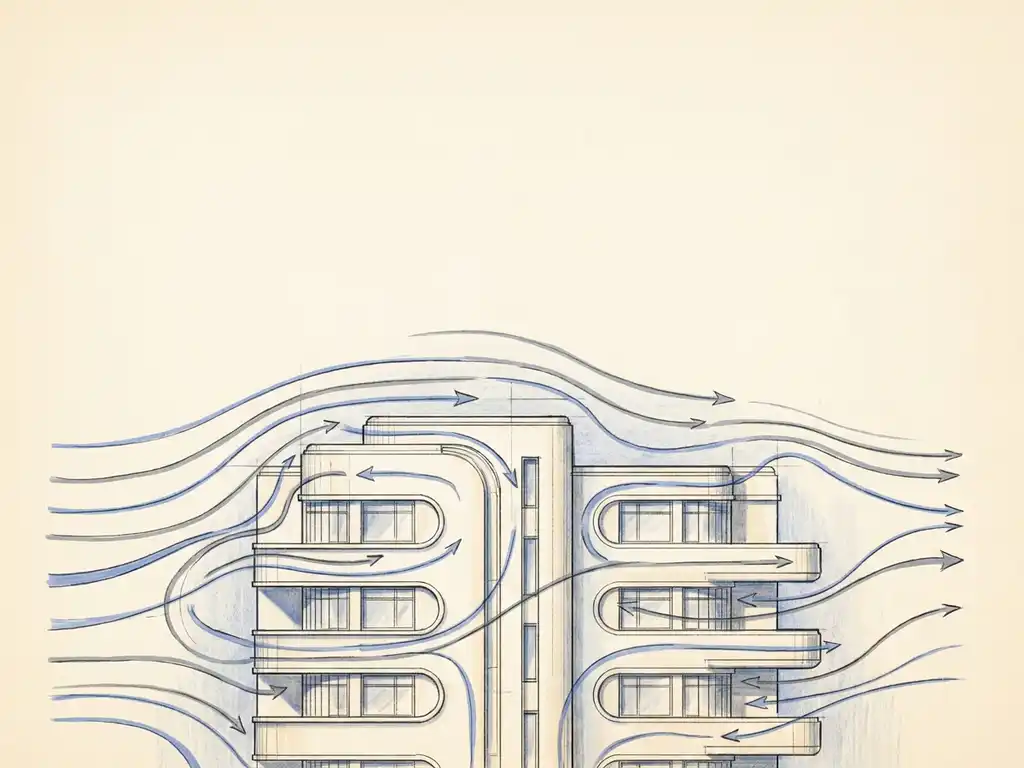
The answer depends on where your project is located and what you need to assess. In the Netherlands, NEN 8100 is the standard for pedestrian wind comfort and wind safety. For projects in the UK and many other international markets, the Lawson criteria are the go-to framework. For wind loading on structures and facades, Eurocode EN 1991-1-4 applies across most of Europe. Below, we walk through each standard, what it covers, and when it matters for your project.
Which standard applies — NEN 8100, Lawson, or Eurocode?
The standard that applies to your project depends on two things: the country where you are building and what you are assessing. NEN 8100 governs pedestrian wind comfort and wind safety in the Netherlands and is required for Dutch permit applications. The Lawson criteria serve the same purpose in the UK and are widely used internationally. Eurocode EN 1991-1-4 covers wind loading on structures and applies across Europe regardless of which comfort standard is in use.
In practice, a single project can involve more than one standard. A high-rise development in Rotterdam, for example, will need a NEN 8100 pedestrian wind comfort assessment for the permit and a Eurocode-based wind loading study for the structural engineer and facade contractor. These are separate assessments with different inputs, outputs, and purposes. Knowing which one applies at which stage saves time and prevents surprises later in the process.
What is the difference between wind comfort and wind loading standards?
Wind comfort standards assess the conditions that pedestrians experience at ground level — how often the wind exceeds a threshold that makes an outdoor space unpleasant or unsafe. Wind loading standards assess the forces that wind exerts on a structure, which determines how a building’s facade and load-bearing elements must be designed. They measure different things and serve different disciplines.
Wind comfort assessments (NEN 8100 or Lawson) produce maps showing how suitable different areas around a building are for sitting, walking, or passing through. These outputs are used by urban planners, architects, and permit authorities to evaluate whether a design creates acceptable conditions for the people who will use the space.
Wind loading assessments (Eurocode EN 1991-1-4) produce pressure coefficients and force values that structural engineers and cladding contractors use to specify the right materials and connections. A facade panel that looks fine on paper may need to be anchored very differently depending on its position on a building and the wind exposure of the site.
Both types of assessment feed into wind engineering work, but they happen at different stages and involve different specialists. Confusing the two is a common source of scope gaps in project briefs.
When is a wind study legally required for a building permit?
In the Netherlands, a wind study is legally required when a building significantly changes the wind environment in its surroundings. This is most commonly triggered by tall buildings, but the obligation depends on local policy rather than a single national rule. Many municipalities require a NEN 8100 assessment as part of the environmental or spatial planning documentation for any building that exceeds roughly twice the height of its immediate surroundings.
A useful rule of thumb from practice: a building that is more than twice as tall as its direct surroundings is likely to cause wind issues at street level. That is often the threshold at which municipalities start asking for evidence. In the UK, a wind assessment is frequently required as part of an Environmental Statement, particularly for tall buildings in city centres or sensitive public spaces.
Even when a wind study is not strictly required, it is worth commissioning one early. Wind problems discovered late in the design process are significantly more expensive to fix than those identified during the schematic design phase. Setbacks, facade orientation, and ground-level layout are all much easier to adjust before the design is locked in.
How does NEN 8100 define wind comfort classes?
NEN 8100 classifies wind comfort by measuring how often wind speed at eye level (1.75 metres above ground) exceeds 5 m/s. The result is expressed as an exceedance probability, which is then matched to one of five classes — A through E — where A is the most comfortable and E is the least.
Each class is then evaluated against the intended use of the space:
- Class A (exceedance below 2.5%, fewer than 219 hours per year): suitable for sitting, strolling, and walking through
- Class B (2.5 to 5%, up to 438 hours per year): good for sitting and strolling, moderate for walking through
- Class C (5 to 10%, up to 876 hours per year): good for sitting, moderate for strolling, poor for walking through
- Class D (10 to 20%, up to 1,752 hours per year): moderate for sitting, poor for strolling and walking through
- Class E (above 20%, more than 1,752 hours per year): poor for all activities
NEN 8100 also defines a separate threshold for wind danger: a 15 m/s exceedance probability above 0.30% is classified as unacceptable. Between 0.05% and 0.30%, it may be conditionally acceptable depending on location. This distinction matters because wind danger is a safety issue, not just a comfort issue, and it can block a permit outright.
What are the Lawson criteria and where are they used?
The Lawson criteria are a wind comfort framework developed in the UK that classifies outdoor spaces based on the activity they are intended for. Like NEN 8100, they use exceedance probabilities, but they define activity categories differently and are applied primarily in the UK, Ireland, and internationally where no national standard exists.
Lawson categories range from sitting and standing to walking and uncomfortable, with a separate unsafe threshold. The specific wind speed thresholds and exceedance probabilities vary slightly depending on which version of the criteria is in use — the original Lawson criteria, the updated Lawson-Hoxey criteria, or the version adopted by specific local authorities such as the City of London or Leeds.
For projects outside the Netherlands, the Lawson criteria are the most widely recognised framework for pedestrian wind comfort. Our team at Actiflow applies the Lawson criteria for assessments in the UK, Gibraltar, and other international markets, and we are familiar with the specific versions required by different planning authorities.
How do wind engineering standards affect design decisions?
Wind engineering standards directly shape how a building is positioned, massed, and detailed. If a comfort assessment shows that a ground-floor terrace falls into Class D or E under NEN 8100, the design team needs to act — either by adjusting the building geometry or adding mitigation measures. The standard does not just evaluate the design; it drives it.
Several design parameters have a measurable effect on wind comfort outcomes:
- Building height relative to surroundings: a building more than twice as tall as its neighbours is more likely to push wind down to street level
- Facade orientation: avoid placing the widest facade perpendicular to the prevailing wind direction
- Setbacks: effective when deep enough — a minimum of 5 metres for a building of around 100 metres tall is a practical guideline
- Street layout: streets oriented parallel to the prevailing wind direction create channel effects; diagonal or perpendicular orientations reduce this risk
- Clustering: grouping towers so they shelter each other (the Manhattan effect) works well when height differences between adjacent buildings stay within roughly 30%
Wind loading standards (Eurocode) affect decisions at a more technical level: the specification of facade panels, fixings, and structural connections. A wind loading study can reveal that certain parts of a facade need significantly stronger anchoring than assumed, which has direct cost and programme implications.
The most important principle is timing. Addressing wind at the urban planning level is far more effective than trying to fix problems at the building level, and fixing them at the building level is far cheaper than discovering them after construction. Standards are the framework, but early integration into the design process is what makes them useful.
How Actiflow helps with wind engineering standards
We help project teams navigate the full range of wind engineering standards — from NEN 8100 assessments for Dutch permit applications to Lawson-based studies for UK and international projects, and Eurocode wind loading studies for structural engineers and facade contractors. With over 21 years of experience and a team rooted in Delft University of Technology’s aerospace engineering faculty, we know which standard applies, what the relevant municipality expects, and how to produce a report that holds up under scrutiny.
- Pedestrian wind comfort assessments using CFD simulations and wind tunnel tests, classified to NEN 8100 or Lawson criteria
- Wind loading studies for facades and structures, compliant with Eurocode EN 1991-1-4
- Clear, colour-coded output maps that you can share directly with clients, planners, and permit authorities
- Advice on which assessment type you need and at which stage — before you commit to a scope
- Experience across scales, from individual high-rise assessments to city-wide studies such as the one we carried out for the city of Rotterdam
- Active in the Netherlands, Belgium, the UK, Gibraltar, and internationally
Curious how we can help with wind engineering standards? Contact us — we are happy to discuss your project and help you find the right approach. You can also find out more about us and how we work.
