
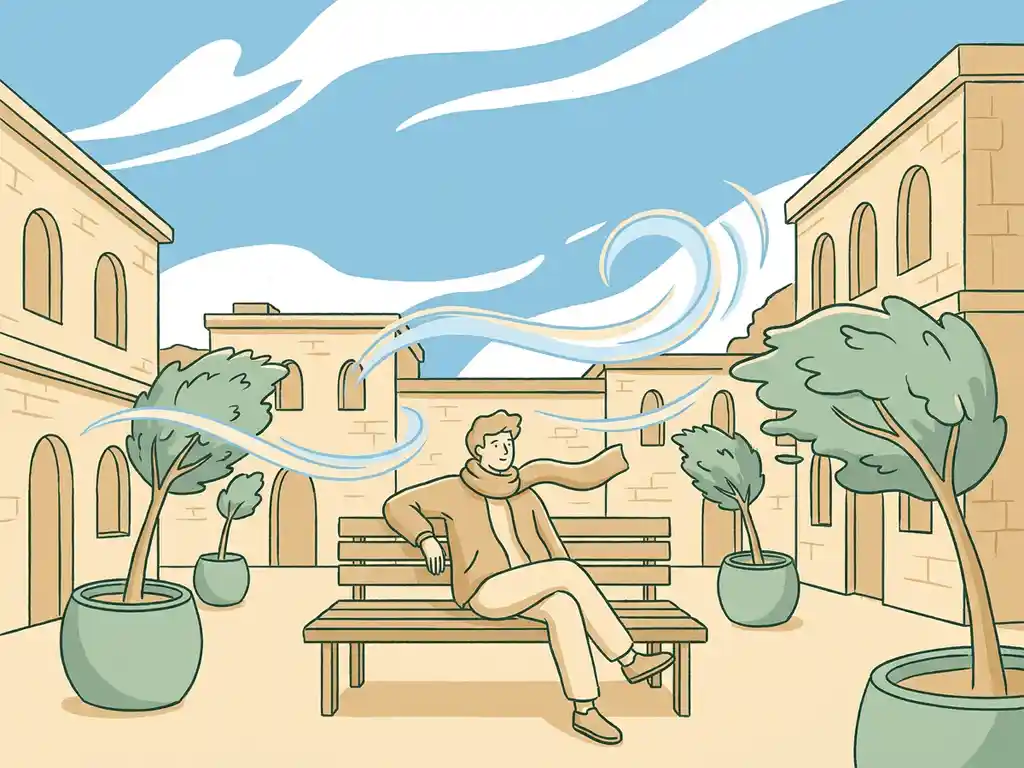
In the Netherlands, public squares are assessed using NEN 8100, which classifies pedestrian wind comfort on a scale from class A (comfortable) to class E (uncomfortable). Internationally, the Lawson criteria serve the same purpose. Both frameworks set thresholds for wind speed exceedance at eye level, but they differ in how classes are defined and which activities they consider acceptable. The sections below answer the most common questions about wind comfort criteria for public squares, from which class applies to your project to what you can do when results fall short.
Which wind comfort criteria are used in the Netherlands versus internationally?
In the Netherlands, wind comfort assessments follow NEN 8100, which measures the probability that wind speeds exceed 5 m/s at eye level (1.75 m above ground). Internationally, the Lawson criteria are the most widely used standard, applying a similar exceedance-based approach but with different class boundaries and activity categories. Both are accepted methods for pedestrian wind comfort assessment, and both can be applied using CFD simulations or wind tunnel testing.
NEN 8100 divides wind comfort into five classes (A through E) based on how often wind speeds exceed 5 m/s. Class A means exceedance less than 2.5% of the time — roughly 219 hours per year — and is considered good for all activities, including sitting. Class E means exceedance more than 20% of the time, which is poor for any use. The standard also includes a separate wind danger threshold: if wind speeds exceed 15 m/s with a probability above 0.30%, a location is classified as dangerous and unacceptable.
The Lawson criteria use a comparable structure but are more commonly applied in the UK, Gibraltar, and other international contexts. We apply Lawson for projects outside the Netherlands, and our team has experience with both frameworks across projects in the Netherlands, Belgium, the UK, and beyond. If you are working on a project where the applicable norm is unclear, the location and the requirements of the local planning authority typically determine which standard applies.
What wind comfort class applies to a public square?
A public square typically needs to meet at least wind comfort class B under NEN 8100 for walking through, and class A for areas intended for sitting or lingering. The appropriate target class depends on the intended use of the square — a busy transit plaza has different requirements than a residential courtyard with seating areas or a children’s play space.
Under NEN 8100, the relationship between class and activity looks like this:
- Class A (exceedance <2.5%): Good for sitting, strolling, and walking through
- Class B (2.5–5%): Good for strolling and walking through; adequate for sitting
- Class C (5–10%): Good for sitting; poor for walking through
- Class D (10–20%): Poor for sitting and walking through
- Class E (>20%): Poor for all pedestrian activities
For a public square with terraces, benches, or play areas, class C or lower is generally considered a problem. The target class is not fixed by law but is assessed against the intended use. A wind comfort study for a pedestrian wind assessment will always map the actual use of each zone against the resulting comfort class.
What wind speeds are considered uncomfortable or unsafe for pedestrians?
Under NEN 8100, wind speeds exceeding 5 m/s at eye level are the reference threshold for comfort. The more often this threshold is exceeded, the worse the comfort class. Wind speeds exceeding 15 m/s define the danger threshold — locations where this occurs more than 0.30% of the time are classified as dangerous and unacceptable for pedestrian use.
To put this in context: 5 m/s is roughly the speed at which most people start to notice wind as disruptive — hair moves, papers blow, and light objects shift. At 15 m/s, maintaining balance becomes difficult for many people, and the risk of accidents increases significantly. The NEN 8100 danger classification distinguishes between “limited risk” (exceedance between 0.05% and 0.30%) and “dangerous” (above 0.30%). The first may be acceptable depending on the location; the second is not.
For reference, a storm is defined by KNMI as sustained wind of 75 km/h (approximately Beaufort 9) for at least one hour. Public squares near tall buildings, bridges, or open waterfronts are particularly vulnerable to exceeding the danger threshold due to downwash and channelling effects.
How does the shape and surroundings of a square affect which criteria apply?
The shape and surroundings of a square do not change which criteria apply — NEN 8100 or Lawson still govern the assessment — but they strongly influence which comfort class the square will actually achieve. Squares with more than 25% open facade on the windward side, or surrounded by tall buildings that cause downwash, are significantly more likely to score class C, D, or E.
Several design factors have a measurable effect on wind conditions at square level:
- Open facade percentage: More than 25% open facade on the windward side substantially increases the risk of wind nuisance on the square
- Building height ratio: A building more than twice the height of its surroundings tends to generate downwash that reaches pedestrian level
- Street-to-building height ratio (H/W): A ratio above 0.65 means most wind is deflected over the roofline; below 0.35, most wind reaches street level
- Adjacent building height differences: Height differences of more than 30% between neighbouring buildings increase the risk of corner acceleration and channel effects
- Square orientation: Squares oriented parallel to the dominant wind direction (southwest in the Netherlands) experience more direct wind exposure
These factors are all captured in a CFD simulation, which models the actual geometry of the square and its surroundings. The Actiflow overview page gives a broader picture of how wind engineering fits into the design process.
When is a wind comfort study for a public square legally required?
In the Netherlands, a wind comfort study is not universally mandatory by law, but municipalities increasingly require one as part of a permit application — particularly for developments involving tall buildings, large open squares, or significant changes to the urban layout. NEN 8100 is the legally prescribed standard for permit procedures, using meteorological data from the NPR 6097 dataset (1963–2002).
In practice, a wind comfort study for a public square is typically required or strongly advisable in the following situations:
- The square is part of a new high-rise development or area redevelopment
- The municipality has included a wind comfort requirement in the environmental plan or zoning conditions
- The square is in a location known for wind exposure, such as near open water or between tall buildings
- The design involves significant changes to building heights or open space configuration
- A client or project stakeholder wants to validate the design before committing to it
Even when not legally required, commissioning a study early in the design process is far more cost-effective than discovering wind problems after construction. Wind issues found late often require expensive facade changes, setbacks, or the addition of screens and canopies.
What happens if a public square fails wind comfort criteria?
If a public square scores class C, D, or E under NEN 8100 — or exceeds the danger threshold for wind speeds above 15 m/s — the design needs to be adjusted before a permit will be granted. The good news is that wind problems are almost always solvable, provided they are identified early enough in the design process.
Mitigation measures follow a clear hierarchy, from most to least effective:
- Urban planning level: Clustering towers so they shelter each other; limiting height differences between adjacent buildings to 30%; orienting streets diagonally rather than parallel to the dominant wind direction
- Building volume and orientation: Setbacks (minimum 5 metres deep for a building of approximately 100 metres tall); avoiding wide facades perpendicular to the prevailing wind; closing or narrowing passages that face the dominant wind direction
- Building-level measures: Aerodynamic facade design (rounded or tapered profiles); covered walkways at least 5 metres deep; canopies (though these shift downwash to the canopy edge rather than eliminating it)
- Public space level: Wind screens; planting (trees and hedges are effective for comfort but not for safety); sunken seating areas or raised edges; relocating terraces, entrances, and play areas away from the most exposed spots
One important principle: solving wind problems at building level is much harder when wind has not been considered at the urban planning stage. The earlier wind is factored into the design, the more options remain available and the lower the cost of intervention.
How Actiflow helps with pedestrian wind comfort for public squares
We assess wind comfort for public squares using advanced CFD simulations and, where needed, physical wind tunnel testing. With over 21 years of experience in wind engineering — and a track record across projects in the Netherlands, Belgium, the UK, and internationally — we know what municipalities expect and how to produce reports that hold up under scrutiny.
Here is what we offer for public square assessments:
- NEN 8100 and Lawson assessments tailored to the applicable norm for your project location
- Colour-coded comfort maps that clearly show which zones meet the target class and which do not — directly shareable with clients, planners, and permit authorities
- Design advice when results show wind hazards, including practical mitigation options ranked by effectiveness
- Fast turnaround — for regular clients, we set everything aside to start the next day if needed, and our internal automation continues to reduce delivery times
- Experience across all scales, from a single square to city-wide area studies like the comprehensive wind assessment we carried out for the city of Rotterdam
Curious how we can help with pedestrian wind comfort for your project? Feel free to contact us. We would be happy to discuss your project and help you find the right engineering solution. You can also learn more about our team and background on our about us page.
