
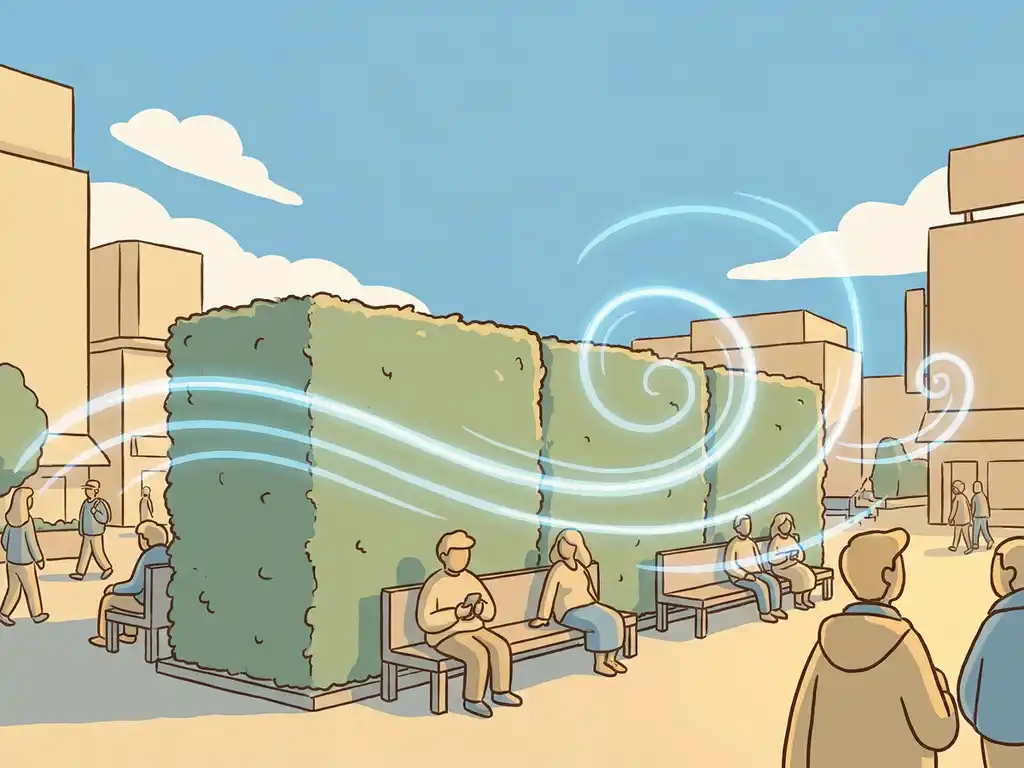
Vegetation can meaningfully reduce wind speed in public spaces, typically cutting local wind speeds by 30 to 50 percent in the immediate sheltered zone behind dense planting. The effect depends heavily on plant type, density, and placement relative to the prevailing wind direction. Trees and shrubs work best as a supplementary measure alongside good building design, not as a standalone fix for serious wind problems. Below, we answer the most common questions about how vegetation and wind speed interact in practice.
How much can trees and shrubs actually reduce wind speed?
A well-designed vegetation screen can reduce wind speed by 30 to 50 percent in the sheltered area directly behind it. The protected zone typically extends to a distance of around five to ten times the height of the planting. Beyond that, wind speeds recover gradually. The reduction is real and measurable, but it is not uniform and it does not eliminate wind.
The key variable is porosity. A completely solid barrier, like a wall, creates a strong but short sheltered zone and causes turbulence at the edges. A semi-permeable screen, like a row of trees or a mixed hedge, lets some air filter through, which extends the sheltered zone further downwind and produces less turbulent conditions at the edges. For pedestrian comfort in public spaces, that trade-off usually favours the semi-permeable option.
One important seasonal caveat: deciduous trees lose their leaves in winter, which is precisely when wind speeds are highest. In winter conditions, a row of bare deciduous trees offers significantly less protection than in summer. If year-round wind comfort matters, evergreen species or a mix of deciduous and evergreen planting is worth considering.
What types of vegetation are most effective as windbreaks?
Evergreen shrubs and conifers are generally the most effective windbreak species because they retain their foliage year-round. Dense hedging species like yew, holly, or hornbeam (when kept in leaf through the winter) provide consistent resistance to airflow. For larger-scale windbreaks, a multi-row arrangement combining a dense understorey with taller trees above is more effective than a single row of tall trees alone.
For urban public spaces specifically, a few practical points are worth keeping in mind:
- Trees in high-wind locations grow poorly. Corner flows and downwash zones around tall buildings create conditions that stress trees and limit their growth. Planting in these spots often produces weak, stunted specimens that deliver little actual protection.
- Large tree canopies can block ventilation. Streets with dense overhead canopies may reduce wind-driven heat dispersal in summer, which matters for urban heat stress. There is always a balance to strike between wind comfort and urban ventilation.
- Ground-level planting fills gaps that tree canopies miss. A combination of shrubs at 1 to 2 metres and taller trees above creates a more complete wind barrier at the heights where people actually feel the wind.
The best-performing vegetation for wind control is dense, multi-layered, and positioned to intercept the prevailing wind before it reaches the area you want to protect. Sparse specimen planting scattered across a square rarely delivers meaningful wind speed reduction.
How does vegetation compare to built structures for wind control?
Built structures, including setbacks, canopies, covered walkways, and screens, generally outperform vegetation for wind control. Vegetation is classified as a Level 4 measure in the hierarchy of wind mitigation options, meaning it comes into play after building form, volume, orientation, and architectural features have already been addressed. It is effective for improving comfort, but it is not a substitute for good upstream design decisions.
To put this in context:
- Building-level measures (setbacks, rounded facades, covered galleries) tackle the source of the problem directly and deliver reliable, year-round results
- Screens and canopies provide targeted local protection but can accelerate wind at their edges and raise concerns about social safety in enclosed spaces
- Vegetation improves comfort, integrates well with public space design, and adds ecological and aesthetic value, but its effectiveness varies by season and species
The practical takeaway is that vegetation works best when the major wind problems have already been addressed at the building design stage. Trying to fix a serious wind comfort issue with trees alone is unlikely to succeed, and it may not even be feasible if the location is too windy for trees to thrive in the first place. A good understanding of wind engineering principles early in the design process prevents this kind of situation.
Where should vegetation be placed to improve pedestrian wind comfort?
Vegetation is most effective when placed on the windward side of the area you want to protect, perpendicular to the prevailing wind direction. In the Netherlands and much of northwest Europe, the dominant wind comes from the southwest, so a planting screen on the southwest edge of a square or terrace will provide the most consistent benefit.
A few placement principles that make a real difference:
- Position planting to intercept the wind before it enters the space, not inside the space itself
- Avoid placing trees directly in corner flow zones around tall buildings, where downwash makes growing conditions poor and wind speeds too high for effective shelter
- Use planting to define and partially enclose outdoor seating areas, terraces, and play areas, reducing exposure without fully blocking air circulation
- Consider the street-to-building height ratio: in narrow streets with tall buildings, planting has limited room to function as a windbreak and may interfere with ventilation
Placement decisions become much more reliable when they are informed by actual wind data. The Actiflow website gives a good overview of how wind assessments and CFD simulations can map the specific wind patterns at a site before any design decisions are locked in.
Can vegetation alone fix a wind comfort problem identified in a wind study?
In most cases, no. If a wind study has identified a location as wind class C, D, or E under NEN 8100, or flagged a hazard under Lawson criteria, vegetation alone is unlikely to bring that location within acceptable limits. Vegetation works well as a finishing layer that improves comfort in areas that are already close to acceptable, but it cannot compensate for fundamental problems in building form or urban layout.
There are also practical limits to what planting can achieve in the locations that most need help. Areas with persistent downwash from tall buildings, or exposed positions above rivers and open water, often have wind speeds that are simply too high for trees to establish and grow well. Planting in these spots may fail entirely or require intensive maintenance to survive.
The most effective approach is to address wind problems at the level where they originate. If the issue comes from the massing of a building, the answer lies in the building design. If it comes from the layout of a development, the answer lies in urban planning. Vegetation then plays a supporting role, not a corrective one. Wind problems are also much easier to solve when they are identified early, before design decisions are fixed.
How Actiflow helps with vegetation and wind comfort in public spaces
We carry out CFD simulations that show exactly where wind speeds exceed comfort thresholds and what is driving the problem. That analysis tells you whether vegetation, building modifications, or a combination of measures will actually work for your specific situation. We do not just flag the problem; we help you find a solution that fits your design and your timeline.
Here is what we offer in practice:
- Pedestrian wind comfort assessments classified against NEN 8100 (Netherlands) or Lawson criteria (international projects), with colour-coded maps you can submit directly to municipalities or share with clients
- Mitigation advice that covers the full hierarchy, from building form and setbacks through to vegetation placement and public space layout
- Seasonal analysis that shows how wind conditions change between summer and winter, so you can make informed decisions about planting species and placement
- City-wide and area-level assessments for larger developments, based on our experience with projects ranging from individual high-rise buildings to the comprehensive wind study we carried out for the city of Rotterdam
- Fast turnaround, with a high degree of process automation that keeps delivery times short without compromising on the quality or defensibility of the report
Curious how we can help with wind comfort and vegetation in your project? Contact us and we will be happy to discuss your situation and advise on the right approach. You can also find out more about us and our background in fluid dynamics and wind engineering.
